Tchaiko Omawale: on afrofuturism, teenage rebellion, and AI overlords
September 2, 2026 | A conversation with the author of May the Happiest Person Win.
✷
Caridad: I'm here with Tchaiko Omawale to talk about her short story, May the Happiest Person Win. And before I get into my interpretations and thoughts and everything, I want to hear just a quick synopsis of this piece from you.
Tchaiko: It's about a really important day to the protagonist and all the things that she's doing to prepare. And I don't think I'm giving it away if I say it's her big day. Her and her girlfriend are going to have sex! And she lives in a place where they're really monitored and surveilled. So she's taking us through the day of all the things that she's doing to get ready so that they can do this. And of course, the unexpected happens and it does not work out the way she wants. And through this, we get to see this world that I've created, that I'm obsessed with.
Caridad: I'm also obsessed with it! Though, I feel like you're underselling it because this is a massive world. Yeah, we have a protagonist and her girlfriend and things aren't what they seem, but this is like the little spark of a gigantic franchise, you know?
Tchaiko: Yes, that's what we want!
Caridad: That's what we all want. And we have like all these themes. The seductiveness of engineered happiness, which you kind of hinted at. Segregation. Social control—it is sci-fi. And we have an ecological catastrophe that probably took place now.
Tchaiko: Yes. We have the Before Times.
Caridad: We're the Before Times! And we have adolescent desire—having sex, but also wanting to be free.
Tchaiko: Yes. Teenage rebellion.
Caridad: Teenage rebellion. Technology versus knowledge, which is also very relatable to right now.
Tchaiko: Yep. Yep. Thank you for all of that.
Caridad: And then wrapped in all of that is like a queer, afrofuturist sci-fi epic. I mean, even in this short story, there are like chapters.
Tchaiko: You know, it's so funny when you were saying afrofuturist, in my head, I was trying to think like which parts feel afrofuturist because I know so much more about the world and what's going to happen than what I wrote. And I've been working on sort of what happens after. I didn't read my own story before the interview, so I'm curious about which parts felt afrofuturist.
Caridad: I'll tell you. For me, it's like the specific haptics and her having to like use her little hand motions to do things. I feel like in a lot of western sci-fi, the technology is separate from the people in the story, like it is the thing that's controlling them. And I find in a lot of afrofuturist media it's usually like the main character who themselves is integrated within like the technology, and the language of that sci-fi cannot be separated from the body of the main character.
Tchaiko: That makes complete sense. Also, when I think about it—I just needed the dots connected—when I think about the people in like bits and pieces that I've been inspired by, I think about Nnedi Okorafor's book Binti, which my little dog is named after. And in that book, Binti is—I can't remember how she describes it—but she is doing equations. And I don't remember if she uses her hands in that book, but you know, I do think of like creating spells with your hands and I talk a lot with my hands. Perhaps the character Binti did that. I'm not sure. And then I'm thinking of N. K. Jemisin's The Fifth Season. The body just seems so connected like even the antagonists' bodies are like very connected to the sort of epic speculative stuff that's happening in the story.
Caridad: Yeah, exactly. And I've always felt like afrofuturism, you know, is very connected. And just any afrocentric literature or media has people connected to the earth in like a very intertwined way. So when it comes to afrofuturism, they're connected to technology in that same way. You know, like using what's around you to your advantage instead of being separate from it.
Tchaiko: Yeah. Yeah, that makes sense. That makes sense. You know, as you're talking, I'm like thinking about artwork by Wangechi Mutu. I'm like picturing Wangechi Mutu's art where there is machinery-tech looking stuff as well as like earth and trees and wood as part of the woman's body.
Caridad: So then when you're finding all of these elements—and I know that you work on a lot of things of like different mediums—how do you choose which elements go in which story and how do you choose which things to expand upon and which things to just, you know, mention and keep going when you're building a whole new vocabulary of a world?
Tchaiko: You know what? That feels easier because they seem kind of obvious where they go. For this story, it was... I'll tell you how this story was like first inspired and it was literally me thinking about the Pied Piper.
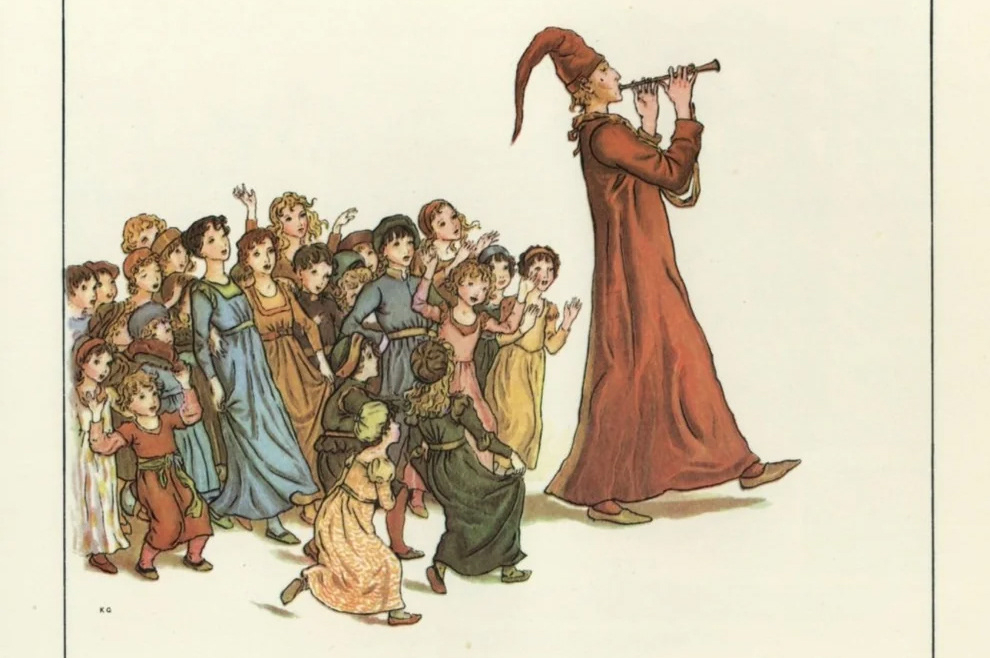
Pied Piper of Hamelin, The c.1880 - Kate Greenaway (1846-1901)
Tchaiko: And after watching the news reports—there's this viral photo from Black Lives Matter, a boy in a Black Lives Matter protest and he's hugging a police and he's crying. Do you remember that photo?
Caridad: Yeah.
Tchaiko: Yeah, and it like went viral and then later on we found out that his two moms had him and a bunch of other adopted children and drove them off a cliff. And so I was like thinking about that and then at around that same time, Amy Coney Barrett, the Supreme Court judge, was doing her run or whatever it is they do to like, you know, be approved, and she had Haitian children. So she's a white woman with adopted Haitian kids, as a Republican whose laws were going to negatively affect people of color, women, etc., etc. And then at around the same time as well, there was like a burial ground found in Canada, I think, outside of a boarding school where like Indigenous people—Indigenous kids—were in this like mass burial grave. And so my trauma response is really to go to magic and I do want to be saved and I want a savior. I was just telling my therapist this morning: I just want somebody to save me. And I was thinking about like how cool would it be if there was like a Pied Piper character that could like go take those children from their adopted white parents or their boarding schools. And that literally all coincided—I feel like it was all around the same time. I think I was pregnant or had just had a baby and I watched The Social Dilemma on Netflix. It was like all my fears and my dreams of finding a savior all put together of just like "oh these tech people are like really in this bubble of their imagination of a new world" and that's how I conceived of the story. But in terms of what goes in the story, it was clear there were two worlds: one world that was like just beautiful and fantastical all because tech made it so and then another world that was unruly and the opposite. Tech. Nature. There's another South African artist whose artwork is more like pinks and blues. His name is Simphiwe. And that was for a different project I was working on, which you know about—my dark fantasy project. I had to create an idyllic fantastical world. So yeah, they kind of just make sense to me, like where it goes. But I think the sort of spiritual DNA or the creative DNA of all the people that I'm obsessed with all come from the same route.
Caridad: Why do you think, both in this story and in a lot of tales of children overcoming horrific things or like finding the truth where adults couldn't, why do you think it is children?
Tchaiko: They're closer to the other side. The unseen side, you know? Like babies, I feel like, know so much more preverbal than we do. And then the longer you stay in this world the more detached you get from what I think is reality, which is the unseen. And I think teenagers—I love them—are very sort of similar to toddlers in that there's like huge hormonal changes going on and your brain is in this like liminal space of "I think I can do it all my own." Like toddlers think that, but you still have to help them. And then teenagers are even closer to adulthood and they also really think, you know, they can have sex, they can have babies, they can do all this stuff, but they still are children. And I think all those things put together make the kind of unruliness that I'm really attracted to. And I think we need an unruliness in order to get to the truth.
Caridad: I agree. And it's also like just being open to everything, because just like when you're a toddler, when you're a teenager, your brain is malleable again.
Tchaiko: Yeah.
Caridad: Something that really stands out to me in the story is the fact that the protagonist lives in this highly tech-controlled world and she's not necessarily trying to separate herself from that. But she also encourages herself and others to like use their own brains and bodies when they can instead of relying on Ohmni, this huge system that is both like your personal assistant but also is like running the town.
Tchaiko: Yes. And running your body and your emotions.
Caridad: Yeah. So she's like open to change but she's also open to protecting herself.
Tchaiko: Right.
Caridad: Do you think this is how most tech should be approached? Like learn to control it instead of abandoning it?
Tchaiko: You know what? I would be a fool if I tried to have like a two sentence on what we should do. I know gut-wise it doesn't feel right to abandon, intentionally. If the cosmos and what we're going through makes it so everything falls apart and we have no tech, like in Battlestar Galactica, like at the end of that, then fine. But I like tech, I really do. I mean, I am scared—I was in an existential crisis for quite a long time about AI, and like tech corporations, but I really do like technology. I'm neurodivergent and it has helped me a lot and I also grew up with a father who was really into technology, and in the 80s before most people had laptops, my dad had a laptop. And it's fun, and I think that young people—I'm not young anymore—but I just think that it's "I don't want it to go away." I just want it to be used so that we can be our highest selves.
Caridad: Yeah, that's probably smart. I mean, I don't think people have ever successfully just stopped the progress of something, you know? You just sort of have to learn. You're not even just learning to live with it, but you're just learning to be integrated with it, which is an interesting parallel in this story. The main character wants her neighborhood to be integrated with the other neighborhoods. And she's also a hacker. So, she's working on how humans can be integrated with the technology in a way that feels more at peace, rather than how it's presented—in this story it's kind of scary, right? It's almost like a threat. Like Ohmni is here to help you, but if you do something wrong, you're going to go to the Vault. You're going to experience the Before Times, which is humans before Ohmni, essentially.
Tchaiko: Us now, or maybe us 10 years later when there's more flash floods and disasters and yeah.
Caridad: Yeah, it seems right around the corner, but you're right, we can't really solve old problems without creating new problems. And also I think it's a mistake to call new tech a problem, it's just a new thing.
Tchaiko: You know what is interesting? I don't feel comfortable saying you can't solve old problems without creating new ones. It feels too much like an assured statement. I don't know. But I know that what's important to me is to question, kind of like the character. She wants to question everything. And I think the reason why revolutions have been started or have the momentum is because of young people, like at 15, 16, 18, 20, you know you're still developing your prefrontal cortex until 25 and in a lot of revolutionary movements, it's young people. And so I just I don't want to be definitive about how we create new problems. I just think we have to keep questioning. Yeah. And I I like the spirit of UluWatu, who, you know, in this story, it's like coming from a rebellious teenage place of like, "fuck all of y'all." Later on in other things I'm working on, there will be an emotional growth of it being not just from a "fuck you" place. But right now in this story, it's definitely like teenage angst of like, "I hate my town. I hate this. I hate that. I hate that." And her hate is an opposition to everybody being the same and not just being boring for her.
Caridad: Yeah. She is annoyed with Ohmni, but she also needs it.
Tchaiko: In the larger story, she wouldn't, I don't think. She wouldn't tell anybody she needs it because that would be like a weakness. But yes, she does need it because she's living in a world where it's how her house was made, but she doesn't feel like she needs it.
Caridad: This story is full of really interesting parallels. She accepts dopamine and stuff to de-stress, but she also tries every time to do like a breathing exercise to calm down.
Tchaiko: Yeah.
Caridad: Right. So, that's like real life. Like you do what you can naturally, but we all have prescriptions that we can't really live without, right?
Tchaiko: I do for sure.
Caridad: Yeah, it's all methods of self-soothing and I felt like Ohmni, in the story, a lot of times, was like self-soothing. It's a band-aid to an issue but it's not solving anything. It's not necessarily, like, evil. It's maybe a little oppressive, which I think UluWatu is trying to explore how oppressive it can be. But if she hacks it, it isn't anymore, right? She can work with it.
Tchaiko: There's more in the story where it becomes less about Ohmni but about who is the founder of the of the town—it's really, I think, where the evil lies as opposed to the like tech itself.
Caridad: Do you feel like the founders invented this tech? We don't really get backstory in this story.
Tchaiko: Yeah, they definitely did. Yes. I don't know how much I should tell of the world because I like to disappear into the world and then take people down! But yeah, it we don't get into this in this story, but the two founders are—one is like the legal component of the creation of the town and the other is the tech component. And they're both, to me and to the protagonist, evil, in different ways. But yes, the tech was created by this person.
Caridad: So even at the top you are mixing body and machine in a very nuanced way.
Tchaiko: Yeah. I mean, how much should I talk about the other... I really love the other co-founder because she's obsessed with God and the angels of the Before Times, and in her part of town there's no tech used. Like instead of robots to cook and clean, like, they get people to do it. And they're obsessed with losing weight. Like her part of town is like obsessed with health and losing weight. And the thinner you are, the sort of more good you are.
Caridad: If UluWatu and Bodhi succeeded in desegregating the neighborhoods and enlightening everybody, is there a part of Sand Hill you think they would keep? Like would they flock to this part where—
Tchaiko: Fashion. I think the fashion world would be—but I don't know if that's just me, but I do think they would be into it. Let me think about this. They wouldn't want to flock to just one part but—oh! You're talking about the part where there's no tech there.
Caridad: Yeah.
Tchaiko: No, I think UluWatu enjoys tech. She enjoys tech.
Caridad: But she also has this like pressure from Bodhi to do something, right? She's like, "if you can hack and you have these powers and you are intensely angry at things, you know, what can we do with that?" I mean, she's the founder's daughter and even she is questioning their world.
Tchaiko: I think it's like chaos would happen. Like delightful chaos. Well, it would be delightful to UluWatu. I'm not sure about to Bodhi, but anytime you upset a status quo, there's got to be some disorder before any new thing comes about. So, I think that to me is what would be fun. If they were allowed to have the fashion neighborhood come together with the husbandry neighborhood, and with the aquatics neighborhood, they'd have fun. They'd have parties and there would also be destruction and there would also be chaos.
Caridad: I like what you just said—that there has to be like a little destruction before things come together. Do you think the AI bubble bursting is what will precede the singularity?
Tchaiko: Girl! Hmm. No, I think Mother Earth is going to do it for us. I don't think... maybe like there's an intersection of it because they're talking to each other. Like the data centers eating up, you know, water and whatnot is also talking to Mother Earth being like, "Fuck all of y'all. I'm going to have flash floods and hurricanes." But I don't think it's going to be... I'm sort of in this space where I'm like really curious about the... it's almost like I'm living in a movie and it's not just one thing that's going to like like have everything fall apart, but it's a culmination of a lot of things and it's going to be epic and it's going to be almost like there was an oracle that has told us astrology, and we're in the time of the age of Aquarius where new systems are supposed to be formed. And like I think it's going to be a lot of stuff and I don't know how it's going to go down. I'm very curious, little afraid, little excited.
Caridad: I can see like people just moving farther from nature out of fear of like climate change and things. So farther from nature, closer to singularity.
Tchaiko: But where can you go? Like literally, I've been looking. I'm so obsessed with this. I've been looking at where in the world is safe from climate change. Colorado, I think, and part of like Baltimore, and I can't remember the other places, but there's going to be fewer and fewer places you can escape to.
Caridad: I mean, yeah, but I feel like it's just something that humans always try to do. I mean, we're so far from nature now, you know?
Tchaiko: We could be even further.
Caridad: We could be on Mars.
Tchaiko: There's just always going to be—I just think there's always a spirit of rebellion and it's just like, I think, part of humanity, until we get wiped out. Or I don't know if we want to be in the context of like an Octavia Butler story where you're then like half alien half human, like maybe that's different, but I really think Earth is alive and Earth is much older and much more powerful than we are and she will say fuck you to all of us.
Caridad: Okay but you mentioned that Octavia Butler story, Amnesty which—
Tchaiko: No, I don't know Amnesty! I know the Xenogenesis trilogy. That's the one I'm thinking about.
Caridad: Amnesty is in Bloodchild and Other Stories and it's like humans and aliens living side by side but the aliens like want the humans to just give themselves over and fully integrate. Because the singularity is touted as harmony. You know, "if you will just stop being scared of us, we can make your world better, we can make your life better." And I feel like that's the parallel to tech now.
Tchaiko: I have a really horrible memory. I think I've read it, but it also sounds kind of like her Xenogenesis trilogy where the aliens are here and there's one human who's like down to like blend with the aliens and all the other humans are not. But that still feels different to me because that feels like organic matter. I think with with AI, it feels like it's the antithesis to any sort of organic creation. Those aliens—I don't remember in the short story, but in Xenogenesis, they needed our cancer cells in order to evolve. And so there's like a sharing. Whereas AI feels like the people now that are interested in expanding it here in the US—I'm not talking about internationally—feels very much like, "you know what, we're tired of women having all the power to make humans. And we're tired of artists who can create things, you know, from their lived experiences. So, we are going to make sure none of this, like, soft power or invisible power that y'all have is going to be worthwhile in our new world because anybody can make a human soon. Anybody can make music. You just have to say this is what I want." And it discounts all the organic, spiritual, and to me, Indigenous ways of being in a way that Octavia's story doesn't feel like that's what's trying to happen. Which is probably why it doesn't feel dystopian.
Caridad: Was this story conceived before the current AI and self-driving cars and robot teachers?
Tchaiko: I think so. I mean, before we all knew about it—and I didn't know there were robot teachers—but before we knew about it in the general zeitgeist. But I'm sure all this stuff has been, you know, in labs and workshops way before. But when I was writing this story, I think it was after I gave birth. So it was during the pandemic. So maybe 2020, 2021 is when this I started to build this world, so it was before everybody was sort of like obsessed with AI, and my brain kind of took me to what happens if these people actually build their own town and build their own city and. And then you know, as the years went by, we saw laws and then yeah. Now I think it's like really easy to read about technofascists and journalists talking about the geopolitical implications of America's AI expansion.
Caridad: Ohmni, I mean, is fictional, but it's like a really unique AI, if you would call it an AI, because it does need its person to operate. It's only doing things to benefit an individual person.
Tchaiko: I think in the larger world, it operates in many different ways. And I know that from like research or stuff I was interested in, people a couple years ago said hardware is not going to be a thing. Like we're not going to have phones or iPads. It's all going to be integrated into our body.
Caridad: It feels very transhumanist, which I feel like is a movement that rose and died.
Tchaiko: The transhumanist stuff—I really enjoy talking to my queer and trans friends about what that means in their context and in the context of human beings, based on anti-black, you know, like sort of Sylvia Wynter discussions. But it scares the fuck out of me to think that there are people who are interested in like "beyond human." Like, I just, I like, I really—as hard as it is—I really like being human. I mean, if I weren't human, I'd want to be a fairy or a ghost, not a technical thing that's in the cloud. It'd be so much more fun to be something else if I weren't human, but not this idea of like machine or something in the cloud.
Caridad: Transhumanism, I feel like, rose and died. Remember Google Glass? That kind of never took off either. So maybe people aren't as—
Tchaiko: Wait, what was Google Glass? The glasses that were—
Caridad: Yeah, Google Glass were like glasses where you could like see your email and like, Google Maps and stuff while you walk around, and people did not buy it. Now, obviously, now we have like Meta glasses, but again, people use—I think influencers, right—use Meta glasses to take pictures and videos of what they're doing. I don't think people are actually yet that interested in like seeing all of that—the internet open in front of you. So, that's good. But they're definitely trying to get that going. They're trying to push it.
Tchaiko: I mean, you know, we'll see with the shorter attention spans and children's brains, if they've like grown up on AI and like all of this extra stimulation stuff. Like their ADHD might get to a place—I mean, this is how my brain works—their ADHD might get to a place where they need to have all that information in front of their eyes. Swipe, swipe, or like whatever. It's too much for me now and too much for my kid now. But who knows? Maybe they'll need that dopamine, you know, in a much faster way. Yeah. I don't know. I hope not.
Caridad: Ohmni releases dopamine. And then you also have this interesting imagery of like emojis and likes on everything that you're doing in real life. The real life Ohmni might be like: do something, see that people are liking it, like in front of your eyes, and that is the dopamine hit.
Tchaiko: Yeah. Yeah.
Caridad: Like that episode of Black Mirror, you know, like being rated and commented on in real life might be the future, but I think there is resistance to it now, at least a little bit. I think the attraction of Meta glasses is surveillance. You know, it's like a cycle. When you are uncomfortable with something or you don't like something, then you do it to someone else. I feel like people are all about not being watched and spied on, but at the same time, they're like, "let me buy these Meta glasses and live stream going up to people" or whatever, right? You take the control back, in a way. So, I want to talk more about this concept of UluWatu hacking the system, what she wants. It seems just for fun—we're talking about like teen angst and all that stuff—but she's also seeking freedom, sexual freedom, athletic freedom, right? Like freedom from the propaganda she receives at school.
Tchaiko: Yes. Yes.
Caridad: She is being pursued by a mysterious, shape-shifting figure that she can't hack and she can't really communicate with. So, what freedom do you think is her ultimate freedom that she would be seeking? What does freedom mean to her now?
Tchaiko: Post this figure sort of haunting her?
Caridad: Yeah. In the next installment of the story, what does freedom mean to UluWatu?
Tchaiko: I mean, she's going to meet this figure and then the freedom for her is really going to be being in that figure's world, because it feels freeing to her to not be able to control anything by hacking. It's such a sort of, uh, delight is not even the right word. Like it scratches an itch that she's never been able to fully like get rid of. And in the second installment or in the TV show that I'm writing, you really get to see how enthralled she feels being in this world that's unruly, which is Nzambi's world.
Caridad: So she's very trusting.
Tchaiko: Well, I wouldn't say she's very trusting, but like a good addict, the thing that titillates you—even if you get warning signs, even if it hurts your body—you still need it. You're still going to keep going after it. And that's the kind of like tension between UluWatu and Nzambi, and what happens with the other teenagers and people.
Caridad: So although she's been trying to assert her own control over her town and her life, she's ready to give up part of that control and see where it takes her. Maybe because she's, you know, she's just been lied to. She learns about the Before Times, everything they show in school versus what really happened. She's susceptible. She's open to anything now.
Tchaiko: Yeah. It makes her sound—I feel like "susceptible" makes her sound weak. Whereas for me, when I was writing it, I was like "ooh, she is the portal to the change because she questions everything." Because she can't be controlled in Sand Hill.
Caridad: Opposite of weak! Opposite of weak. And you're talking about "like any good addiction," but it's also just how trauma is a lot of the time. After something happens to you, you now interact with the world differently. You're open to different things, right? You can see things differently, process them differently. So I feel like this was UluWatu's specific trauma. I mean, one, her parents bring home a Thrall—insane, right? She's been the one hacking and controlling the tech in her house and she thought her parents were above all of this.
Tchaiko: Yes.
Caridad: Now it's there in a much bigger way than she's experienced before. Two, she experiences the Vault. She sees not just forests burning and things, but humans hurting each other. And this is just not the world she's been told. So she's traumatized and in that moment, Nzambi appears to her, right? And speaks in riddles and everything. But I think that would be the time, if there ever was a time, that would be the time to be like, "Okay, let me take your hand. Let's do it."
Tchaiko: "I'm ready to choose something else. I'm ready." Yeah! Yeah. It's so funny. I never broke it down in that way, but yes, the feeling of betrayal—it's almost like a feeling of betrayal when her parents bring the Thrall. And that's the sort of split in the before and the after for her.
Caridad: Absolutely.
Tchaiko: Yeah. Yeah.
Caridad: Yeah. And I also think that's the before and after of like her adolescence in the story, right? She's sort of angry in the beginning and she does want to pursue Bodhi and she just wants to get those sneaky kisses, and then it becomes very difficult, right? To focus on their plan. She was 15 years old and however many days here, but now she's almost 16 years old, right?
Tchaiko: At the end of the day.
Caridad: By the end. Yeah.
Tchaiko: Yeah. And there's so much more that's gonna happen. It's like within a whole day, everything just like took a complete turn from like what she's used to being able to control and do and make happen and predict, where it feels like an ambush when she comes home to the Thrall. So that's one thing. And then being at the school, still trying to go through with her plans but nothing working out. And not just that, but an introduction to something completely inconceivable to her.
Caridad: Absolutely. I feel like when the Thrall is in her home, pushes her to the ground, has her pinned, and shows her those horrible Before Times, it's like literally pushing that little bit of innocence right out of her. She was having her romantic and sexual awakening and that is just pushed right out of her and replaced with, like—she's being radicalized.
Tchaiko: Destruction. Yes.
Caridad: Yeah! Destruction. And like purposeful anger, the necessary things in a story like this. Absolutely. And then, you know, she wants everything to be intertwined with Bodhi. But Bodhi is also like a symbol of before this, right? That was like an easy, mischievous thing that she could pursue, but now Bodhi doesn't know what she's experiencing. Bodhi hasn't seen Nzambi. Bodhi wasn't scared by this Thrall, and so they can't really go through this political awakening together.
Tchaiko: No.
Caridad: Do you think do you think they're going to make it?
Tchaiko: That's what I'm writing now and I haven't decided yet if I want Bodhi to come out on the other side being on team UluWatu and Nzambi. I haven't decided yet because there's so many different things that happen and Bodhi believes in their town so much, even though she wants to do different things. I'm very interested in people who betray the revolution, whether it's the enslaved person who told that people were going to escape or whether it's the person who worked with the FBI and CIA for the Black Panthers. Like I'm really fascinated by somebody who starts off for the change in the movement but is so embedded in the status quo they almost can't help themselves but to betray. So I haven't decided yet whether that's how she ends or whether there's a transformation and an evolution for her. I don't know yet.
Caridad: I know. What could radicalize Bodhi? Because you're right. She does love this town. She doesn't love the status quo, necessarily, but she loves, you know, the town that's built. She loves the safety of it. That's hard to break out of.
Tchaiko: Yeah. She just wants a little change, you know? She loves the table. She just wants to bring a couple chairs to it.
Caridad: I think a lot of times, people have a hard time, you know, empathizing with a situation even small or global if it isn't personally affecting them—which, everything is personally affecting everyone, I think—but a lot of people are like, "Oh, yeah, I have this so this doesn't bother me and therefore I won't speak out about it. I won't help my neighbors." And I feel like for Bodhi, that's going to be a real journey for her. She's like, "I love my family. I love my school."
Tchaiko: "I love my town."
Caridad: Like, what exactly would be her motivation to change those things?
Tchaiko: I think when you're a people pleaser, you sometimes don't know who you are. And so, your motivation is to really make everyone pleased. So, you're like a pingpong ball going this way and that way. I think that is the motivation of Bodhi, and the question is whether there comes a point where she falls from grace and does she choose change or continue to people please? The larger story gets to a place where it becomes about choices that we make, like choices that the other teenagers make and whether they want to fuck with Nzambi and UluWatu or they want to like stay in the status quo. And I feel like we are at a time right now in this age of Aquarius, in this very particular time, where I do think we're being asked to choose. Whether you say it out loud or not, there are choices being made.
Caridad: Like choosing us versus them? Or just choosing the planet versus us?
Tchaiko: Yeah. Like I would rather say the planet versus destruction. And I think we're heading to a place where it's so... I think we've probably passed the tipping point. I'm not sure, but where it really is, like—are you going to choose to ignore what is happening to Earth and how it's affecting all of us or are you going to just keep going? And I literally think it's going to be that binary. Like we're at that. Yeah.
Caridad: And Nzambi will usher in this change.
Tchaiko: Yes! Like any good trickster, like any, you know, like any good Captain Chaos. Yes. The trickster figure is great for that. Teaching us lessons, but it in a roundabout way.
Caridad: Well, I don't want to give away more of this world. If we go further into just things about Nzambi, that's a whole—
Tchaiko: I know, that's not even in the short story!
Caridad: They're not in the short story yet! But it's extremely provocative, obviously. I mean, a shape shifter who has only appeared to UluWatu as the things she desired at that time, even though she didn't know it, right? A pink dolphin and then a tree. And that gives us insight into her psychology a bit. Into UluWatu's psychology.
Tchaiko: The things that are—yeah. The things that are her—I think almost I want to say desire—but yes, the things that are—
Caridad: Her subconscious desires.
Tchaiko: Yeah. Yeah. Have you read the N. K. Jemisin book The Hundred Thousand Kingdoms? It's a trilogy, but in that world, there are gods who are prisoners to humans. There's a whole interaction with a specific human that the gods have like chosen, of like why they're going to find their freedom through her. And so I really—yeah, that was one of the inspirations as well, which again, this part is not in this short story, but in Nzambi's world.
Caridad: I get that.
Tchaiko: You do get that? Okay, good, yeah.
Caridad: I do get that. We see them in different forms. I feel like Nzambi is ecological, mythological, even like spiritual even though we haven't seen the other watcher who's really into God and stuff. Nzambi really represents all those things, and anyone's subconscious desires.
Tchaiko: Yes. Yes.
Caridad: Powerful! Well, what can we expect from this story going forward? I know you wanna do a script.
Tchaiko: I have a limited series. At first it was a movie and then I was like, "Oh, I want to get more into the, like, characters." So, I kind of started fleshing it out, ideating as a limited series, but I think that this world just—it would be so cool to have many iterations. I was in an emergent technology class and me and my group built a VR game around the world. I would love for this to be a game because it would be a way in which the player or players could interact and make choices in a game that is a parallel to the choices that we're making here. Or like, can get people thinking in a more embodied way, like how they're responding and participating in this turning point that we're in with technology and with the Earth.
Caridad: The age of Aquarius. Exactly.
Tchaiko: Yeah. Yeah. And I wanted to actually do like, not a graphic novel, but almost like an experimental... where it's like some text and some images, but I just want to live in the world and have other people also like contribute to the creative ideation of the world!
Caridad: Tchaiko, where can we see more of your work?
Tchaiko: You can go to my website, www.tchaiko.com, or I'm on LinkedIn. Instagram is not reliable, but you can go there. There's lots of dance videos and you can see other videos I've made. My TV work—I've directed Black Mafia Family, a drug trafficking soap opera is how I like to describe it. Queen Sugar, Cherish the Day, Good Trouble.
Caridad: My favorite episode of Good Trouble!
Tchaiko: You saw Good Trouble? You saw my episode?
Caridad: Yeah! It's literally my favorite episode of the show.
Tchaiko: And then Solace is my first film that I would love everybody to watch. It's about a girl who realizes she has an eating disorder after moving in with her grandmother, and trying to figure out new friends. And it's on Prime and MGM Plus. Yes, MGM Plus, Prime, and then also kweliTV if you're international.
Caridad: I hope everyone goes and watches those things! Tchaiko is one of the best.
Tchaiko: Thank you. Thank you.
✷──────────✷──────────✷
Tchaiko Omawale is an award-winning director, writer, and third culture kid who has always used magic and folklore to navigate her constantly-changing landscapes. She recently received the 2024 Creative Capital Award for her fantasy feature film project, BEAST.