✷
“Gimme a sec,” Matthew said to the man in the suit. He dropped the wrench and walked to the desk in the corner of his workshop. Then, he sank into the swivel chair. The man followed. Matthew bent down and grabbed a Coke from the minifridge. He drank half, wiped his mouth, and looked up.
“So, what can I do for you?” He asked. He was craving a cigarette.
The man had a sunken face and deep rings under his eyes. Pale skin stretched over his face like a mask.
“Mr. Cunning?” His voice was quiet but seemed to fill the room.
“Yes?” Matthew looked into his black eyes.
“My car.”
“What’s the damage?”
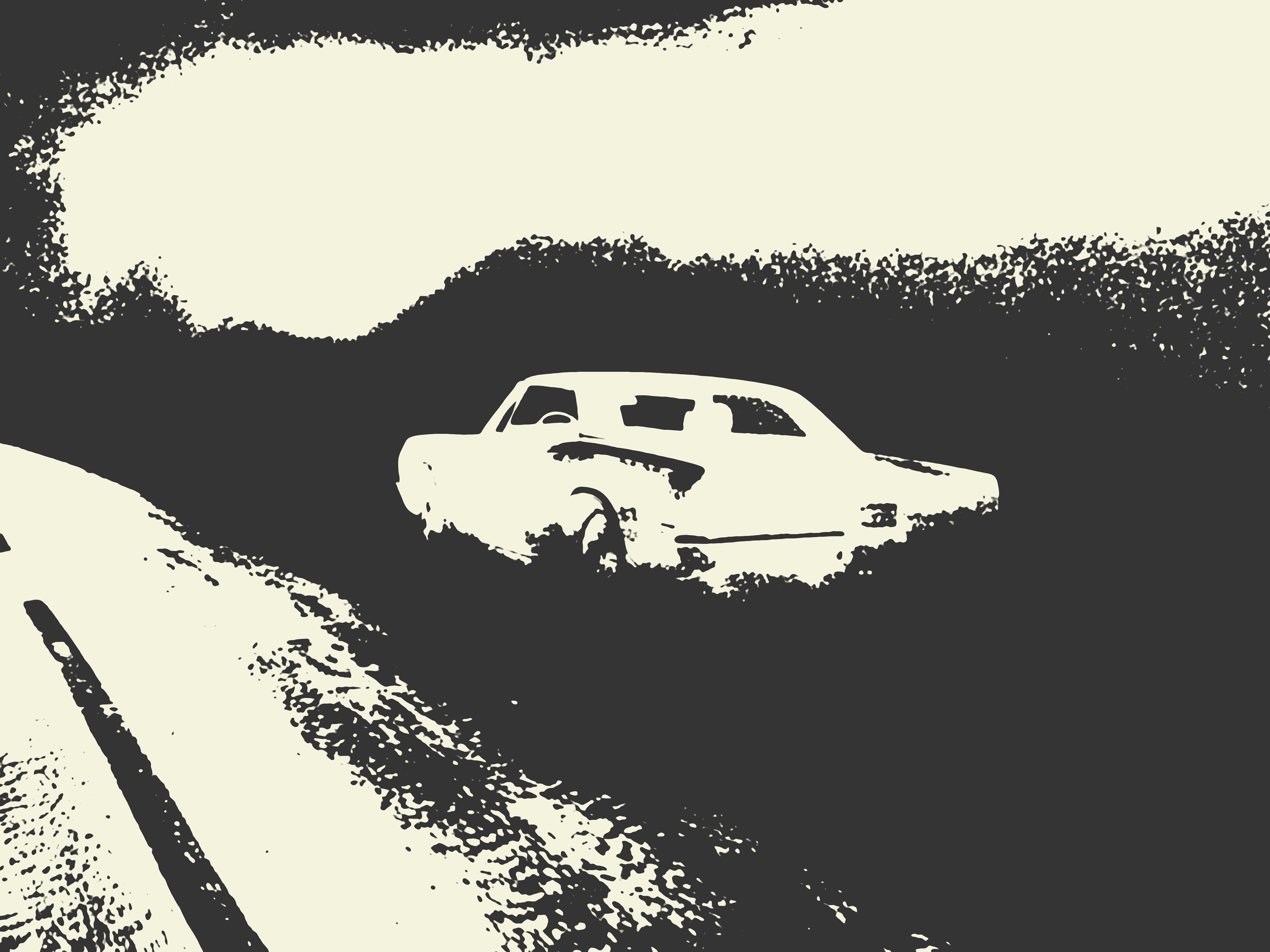
The man pointed to a car parked outside the workshop. Matthew saw it through the open gate of the garage, shining in the afternoon sun.
“Come and see.”
The man, turning his back, walked through the workshop in a smooth manner. Matthew followed. When they got to the car, he inspected it.
“It’s old,” he said. The man did not respond.
Matthew felt hot metal burning his hand as he put the aluminium rod underneath the hood. The engine was old and covered in rust. Two different liquids were leaking. A cable had lost its coating, showing bare, red copper. He was about to lean in further when he felt its looming presence right above him. He looked up. The thick metal plate, hanging above his exposed neck, unnerved him. He pulled back.
“Everything all right?” the man asked. Matthew did not answer. He looked down. The sun made his shadow stretch out beside him. He could see it disappearing into the car’s shadow, the man next to it. Matthew was about to speak when he saw it: the only shadows on the ground were his and the car’s. Where the man stood was nothing but a gravel road, tainted in light.
“Another look?” the man pointed at the damaged engine.
“No.” Matthew’s voice was quieter than usual.
“What’s the problem?”
Matthew didn’t respond.
“What’s the problem?” the man repeated.
Pulling his eyes away from the ground, Matthew looked into the man’s face. He smiled. His teeth were bone-white.
“The radiator and oil must have started leaking. There are drippings of two different liquids.” He pointed. “Black and white.”
“Bad luck,” the man said, and the next part he mumbled, “sometimes you have got bad luck, I suppose.”
At that moment, the wind picked up and whipped Matthew’s face. Dust flew into his eyes and mouth and made him cough. An old cough like an engine oiled by thirty years of cigarettes.
He sounded like his old man, he thought. He had been a smoker. Matthew remembered him coughing in the hospital. Back then, he had been glad to see his father like this. For the first time in his life, he always knew where he was. As if the cough had made his presence known to him. Sometimes he wished the old man had died right then and there.
Matthew blinked. The wind calmed, and the man kept grinning. Only now did Matthew realise that the man had not blinked once since they’d met. The entire time his piercing look had seemed intentional, but Matthew looked closer. The man had no eyelids. Torn open, black—fixating him.
“I’m sorry, but I can’t fix this,” Matthew said, gesturing to the gate. “Please leave.”
“Are you sure?”
“Yes. I can’t help you.”
The man seemed amused.
“You don’t make it easy, huh?”
Matthew’s eyebrows furrowed. He had heard that phrase before. It even had the same intonation.
The lights too harsh. A fly buzzing around the hospital room. The old man zapping through channels—constant noise.
Matthew felt his pulse pressing against his neck.
“Do you have children, Mr. Cunning?” the man asked. Matthew slowed down his breathing. Then he responded.
“I have a son.”
“How is it?”
“I try my best.”
“More than a lot of fathers do, I’m sure.”
Matthew stayed silent. The man’s distorted smile disappeared.
“What’s that?” he pointed at Matthew’s arm.
Matthew looked down at the round little scar.
“Nothing.”
“Sure looks like something.” The man tried to take a closer look.
“None of your business,” Matthew said and put his hand over it. As soon as he felt the raised scar he wanted to rip his hand away.
“Oh, I did not mean to pry. I was intrigued.”
“A burn.”
“Pretty deep one.”
“Just a burn.”
The man looked at Matthew.
“Say—are you afraid of something?”
“Ain’t everyone?” Matthew asked. The man’s smile came back.
“I suppose so. But I asked are you afraid of something.”
“I don’t know.”
“Come on.”
“I don’t know,” Matthew said again.
The man muttered something while staring at the ground.
Then he looked up and said, “I’ll be back when you are ready.”
“Ready? What? To fix the car? The car is beyond repair, I’m afraid,” Matthew said.
The man stepped close. Matthew saw the smoothness of his face. There were no pores. His skin resembled soap, with a scar running vertically up his throat. He smelled of nothing, and still familiar. Then his pale lips moved to Matthew’s ear.
“Name it,” he whispered, and then he turned around and walked away. Matthew stood still. After a minute or so, he came back to his senses.
The car was still in front of the garage, blocking the driveway. As he went onto the street to see if the man was still nearby, he stopped. Not only had he disappeared, but the street in front of the workshop, which was usually bustling with life, was empty. All Matthew could hear was his breathing and a breeze that cooled him. Going back into the yard, he felt as if he were looking at himself from the outside.
He tried moving the car by himself, pushing against the hot metal, but was unsuccessful. Its doors were unlocked. He got in and took the plastic cover underneath the steering wheel out, putting cable after cable against each other. It surprised him that even then the car would not turn on. The inside smelled like the man: clean, antiseptic—familiar. There was a wallet on the dashboard. He did not touch it. After trying for a while to move the car, he went back inside, sat on the swivel chair, and lit a cigarette. His hands were shaking as he smoked.
Afterwards, Matthew closed up shop and went home. His wife, Helen, had made dinner. When they were all sitting around the dinner table, Matthew tried to be present.
“Ben got shouted at in school today,” Helen said. “Isn’t that right?”
The kid looked down at his plate.
“Doesn’t matter,” Matthew said. Ben looked up.
“It wasn’t even my fault,” he said.
“It never is,” Matthew said.
“No, really, I was trying to help this kid, but he—”
Matthew held up his hand.
“I don’t care. Don’t do it again.”
Silence. Then the kid’s voice again: “Were you ever shouted at?”
“Sure.”
“Why?”
“That’s how it was.”
“You don’t know why?”
“No.”
“Did you deserve it?”
“No.”
“See, me neither.”
Matthew told himself to stay calm. To listen. To breathe. Then he shouted with blind anger, “Shut up and watch your mouth. You don’t know what the fuck you are talking about, boy.”
He looked at his son. Ben’s lower lip quivered, and he could see tears in his eyes. Then he looked down at his plate. Couldn’t chew. Just sat there, jaw tight. After a minute, he glanced at Helen.
“Sorry,” was all he could say.
Ben finished his food, and Helen sent him to bed. He went upstairs, and she turned to Matthew.
“How dare you talk to our son like that.”
“It was a mistake.”
“You never scream at my kid like that again. You understand?”
“There was a lot going on at work today.”
“I don’t care. I was in the office and had one crisis after another. Do you see me screaming at him?”
“I’m sorry.”
Matthew looked at the ground. He wanted a cigarette.
“You will apologise tomorrow.”
“Of course, I am sorry.”
Helen put a hand on his shoulder.
“I know you are, but this is not okay.”
Matthew felt a pressure behind his eyes.
“But the kid cannot compare his childhood to mine, right?” he asked.
“Mat, he wasn’t. You felt like he was, but he wasn’t.”
She sat beside him. He wanted to hug her but only managed to hold her hand. They sat like that for a minute.
“What was going on at work today?” Helen asked.
“Someone left their car in the yard. It’s still there. Headache to move the damn thing.”
Helen stood up and hugged him from behind, her arms around his shoulders and her mouth next to his ears.
“You’ll figure it out,” she whispered, kissed him and went upstairs.
He went outside and smoked. Helen was right. How could he have lost control like that? Never again. Never like him. He should go upstairs and apologise. But the boy was sleeping. He would do it later.
Back inside, he dropped onto the couch and turned the TV on. The news: a kid had died in a car crash on the I-41. The car went right into oncoming traffic. A reporter was standing in front of an ambulance. The screen tainted the room in blue, rotating light.
The ones at the hospital had looked the same. He remembered looking outside the window and seeing an ambulance drive away. The nurse had changed the catheter and left.
Matthew closed his eyes. It was okay, he told himself.
“Why?” he had asked in the hospital. He had made the question sound like a plea.
His father’s sad, bloodshot eyes stared up at the ceiling. Then he looked right at Matthew. The look was soft, expectant. Like he wanted Matthew to take something from him.
“You don’t make it easy, huh?”
The nurse had to change the bandages around his wrists every couple of hours. The old man had been lucky Matthew had found him. All alone in the bathtub. Lukewarm water. Lights turned off. His bandages would soon again turn light red. It was as if they were fishing again: dawn bleeding into a cold lake.
“Should I?” Matthew asked. A film of water covered his father’s tired eyes. Oh, how sad he had looked.
“Think they could play me some Cash?”
Matthew couldn’t look at him.
“I’ll ask the nurse.” His voice was strained. There was a pause. The old man looked down onto his tube-covered hands.
“I was scared. But I tried. I really did.”
Years later, driving to the morgue, Matthew thought about what he had said. He remembered their last road trip to Wisconsin. They had spent hours listening to that same Cash cassette tape. Not saying a word.
There’s a man going around taking names.
Then the car broke down. The old man was talking about fishing while he fixed it, and Matthew listened. He told him about the difference in bait, the fish they’d see, and how he would always carry a new fishing hook with him wherever he went.
“Why?” Matthew had asked.
“So that I can survive no matter what happens,” his father said. Then he had shown him how the engine worked, and they got back in.
“What a man,” his father had said as they listened to the same tape again.
At the morgue, Matthew had to identify the body. They found him in an alleyway. At that point, Matthew hadn’t spoken to him in years. They only found a wallet on him. He had been drunk. It was his father. Matthew didn’t cry. He remembered him, lying there. Alone.
The TV had moved on from the news. Matthew turned it off. His hands twitching, eyes fixed on a point in the distance, he was debating. Then he stood up and went down to the basement.
There was nothing written on the old cardboard box. He brought it up, his hands leaving thick prints on the dust. It was the only thing he had kept from him. All that was inside were records and tapes, most of them by Johnny Cash.
That Wisconsin trip had been between them. Soon after, his father had lost his job. Matthew remembered how his cough got worse. He would come home and find the man swaying on the couch, smoking. Sometimes when Matthew coughed, he saw that image. Stained shirt. Boxers. Yellow fingernails. Smoking. A waste of space.
Matthew did not realise that he had put the tape on. As if he had been in a trance.
“There’s a man going around taking names.”
The man had said the same thing as his father, even had the same intonation: “You don’t make it easy, huh?”
Why would he? In the end, his father was his father. He deserved to have someone look after him. Keeping him alive. He had tried. They had gone fishing together. He had caught a trout after a day of hard work. The old man had helped him reel the fish in. He had even taught Matthew how to fix a car. Between it all had been a man—trying.
But in the end, it didn’t matter. The last memory he had of him: a naked, old man lying on cold metal. Mouth just barely open. How close he got to his face. He had looked so peaceful. His red nose and acne scars like fields that would never be discovered again. Matthew remembered being afraid of him opening his sad eyes at any moment; but he didn’t. There he was, so close. Closer than ever in life. His hair wet as they had washed him, but he still smelled… Matthew stopped.
The man, the car, his father—the same.
Cash finished the song.
✷
The workshop was dark. He could just about see the lock to open the front gate. As he walked through, he could barely make out the outline of the car. He pulled at the driver’s door and sat inside.
The wallet was still on the dashboard. For a moment he hesitated. Then he decided to not open it. He put his hands on the steering wheel and felt the leather. The car was a reliable one. He rarely had to fix cars like it. They did their work and did not complain. He wasn’t sure what he was doing here. Just intuition. He closed his eyes.
He imagined himself driving down the mountain road, Ben next to him. Wisconsin wilderness outside, while the boy would look and listen and feel warm in his presence. There would be a curve, and he would turn the steering wheel, and, in the morning sun, the light would shine through the leaves of the forest and in his face. He would squint. Point out the lake. Talk about trout.
Matthew shifted into first gear.
Ben would ask questions, and he would answer.
He moved his foot off the clutch. Just enough. There was the old familiar noise of an engine coming to life.
They would drive towards the lake, and he would hum a song.
He pushed his foot down onto the gas, let go of the clutch and, with a satisfying noise, the car moved. As if it was always meant to work. He drove through the open gate onto the main street, which was the mountain road, which was the main street.
He opened his eyes. Everything was black, but he was driving—the headlights cutting through. He looked into the rear-view mirror.
The bone-white smile and the black eyes were looking right at him. He was sitting there, a cigarette between his thin fingers, blowing out smoke.
“Are you afraid?”
“Yes.”
“What of?”
“I don’t know.”
“You do.”
A moment.
“Of you.”
“Me? Who am I?”
“You know who you are.”
“Do I look like him?”
“No, but you give me the same feeling.”
“Do you look like him?”
“People say so. I don’t see it.”
“Doesn’t matter. It’s a feeling, as you said.”
“What do you mean?”
“It doesn’t matter how you look. It’s the damage, the feeling.”
“And what can I do?”
“Name it.”
Matthew looked ahead. He heard the man coming closer and felt a burning sensation on his arm, right where his scar was. He didn’t look down. Just kept the car steady. It was excruciating. After a while, the pain went away. The car had left the city and was driving out into the country. Darkness engulfed them. He smelled the man in the back seat and looked in the mirror. He was not smoking anymore.
“Name it,” the man said again.
Matthew didn’t answer.
“Go on. Name it.”
Matthew touched the scar on his arm. The raised bump was still warm. For the first time in his life, touching it calmed him down. He remembered the old man crying after seeing what he had done. “I’m sorry boy,” he had said, “I didn’t mean to...” and he had cried with the young Matthew, who was holding his arm in pain, the burning cigarette still on the ground.
He remembered that the old man never wore short sleeves at home. He also never swam with Matthew in the lake since he claimed he didn’t like the water. But once, Matthew saw the old man dry himself after a shower. His chest and arms covered in small, round scars.
“I’m trying.” Matthew said to the man.
“Trying ain’t naming.”
“What is there to name? You and I know it already.”
“Then say it.”
Matthew breathed in.
“I’m afraid of him. That he is me.”
“He is you. You are him. What’s the difference? The question is what can you do about it?” the man asked.
Matthew looked straight ahead. Just up ahead headlights were coming towards them on the other side of the road. He closed his eyes and pushed down on the gas.
“There you go,” the man said.
It was a clear day. The sun was shining through the leaves. With Ben beside him, he would take the wheel and lightly steer it towards the mountain road. He’d chat about trout, Cash, or something else.
“Now you’ve got it,” the man said.
The engine was howling. The car was too fast now.
While Matthew was talking, Ben would look at him and he would see it in his son’s face. Would see Ben’s proud smile and see what he thought: what a man his father was. The man he himself had never had.
“I think this is goodbye,” the man said.
Matthew opened his eyes. The backseat was empty. Then, he heard metal scraping and a loud horn. It was there he felt it. Felt the damage he had done and how he would not be part of it anymore.
He pushed the steering wheel around and held the car steady. Headlights flushed his face. Tyres squealed. He heard the horn scream past and then felt a force that pushed him out of his seat. The seatbelt cut into his flesh. Pain. Then silence. He had grazed the oncoming car.
He stopped at the side of the road and breathed until his heartbeat calmed down. He looked into the rear-view mirror again. No one there. He was alone. Then he cried. So much that his eyes swelled up and his shirt got wet. The silence of the car echoing with deep, rhythmic wails. After some time, Matthew stopped. He wiped his eyes and looked down. There was the wallet on the ground. Still closed. He picked it up and opened it. It was empty, except for the fishing hook that fell into his lap. New, for small-lake fish and ready to use. A loud laugh escaped Matthew, and, after a minute, he turned around to drive back home.
On the way, he kept thinking the same thing: what a man his son would be. What a man.
✷──────────✷──────────✷
Kian Afsah-Hedjri is a German–Iranian writer based in London, currently working on his first novel. When he is not writing, he makes music, takes photos, or spends too much time on Letterboxd. More of his work can be found on his Substack: kianafs.substack.com