✷
Juneblue swung his hatchet like a hornet stuck under someone’s skin trying desperately to break free. He chipped away slowly at the trunk, despite his vigor; he wasn’t the strongest tree-feller in the world, but he was one of the most persistent. His thin arms moved with lightning speed in repetitive, wide-arcing chops that sent bits of woody shrapnel flying from the formidable tree and left a comparatively small dent in its surface for the amount of effort expended. His task would have appeared Sisyphean to anyone observing his diligent labor if they didn’t know who he was—for his pedigree was exceptional.
The young chopper had been born to a family of farmers about twenty-five years ago—no one recorded the exact day or month or year of his birth, for they didn’t think it important in the area he came from, where people mainly relied on solar patterns and seasons to approximate their understanding of the passage of time. His parents called him Juneblue Barrington Oaks: a diligent name for a diligent worker, his father had said. And he was a diligent worker, in his own way.
Juneblue was a hellion growing up, strong-willed and rambunctious with a mind drenched in defiance. He disobeyed at school and home, often screaming and throwing things at teachers and his parents at the slightest perceived provocation. He steadfastly refused to do any work to help around the farm. His five older siblings tried to reason with him for a time, but after years of effort they gradually grew to despise him for his insubordination. His sister, Annemarie Dovetail, claimed that the stress his behavior induced caused his mother to have a nervous breakdown. The crackup had led her to visit a hospital for treatment, where she contracted pneumonia—which, even after she had recovered, caused her to wheeze interminably and often succumb to periods of unexpected and painful shortness of breath. Juneblue either didn’t believe her accusations or didn’t care—so he continued in his wild ways, unfazed and untempered.
He was destined to be the Tree Slayer foretold in so many fables and dreams. The prophets of his time and place had spoken, and he was fated to follow in their vision-imprinted footsteps.
His family arrived home late one evening (they had gone to see a movie in town, which he had refused to attend) to find Juneblue violently attacking the beech in front of their garage. The bark peeled off in violent angles like pulped lightning, splintering into sharp streaks of dismembered wood. Dust from the assaulted trunk covered his face in a light coat of earthy brown, delicately forcing his eyes half-closed and filling his nostrils with a scent of the forest that flowed through his nostrils in arborous poetry, wordless songs of ancient woods coursing through him in currents of life and creativity set free by his destruction. Finally, he was at peace.
So he had found out who he was and what he was for. But so what? Many others had done the same, and where were they now? In the grave or behind a desk, locked in a cubicle or buried beneath the ground like the roots of the trees he longed to destroy. He must find something to do with his purpose, something useful and ripe with meaning, otherwise he would end up wasting away his time just the same as all the other anonymous faces—the false Slayers, the pretenders to arborous glory—who had fallen before him into the oblivion of comfort and routine.
✷
In the land where Juneblue lived there had once lived a civilization that built shrines in the forests, and when this civilization fell under attack by the one that supplanted it (the same that eventually gave birth to our protagonist), its citizens—who were all priests and sinners equally; they had no formal religious hierarchy—began to secret away their altars within the trunks of their beloved trees for safekeeping. This would ensure their protection, they hoped, from the destructive forces of the invaders, who at that time showed little care for the forests and much interest in the prairies surrounding them, hoping to develop the land as part of an unrelenting agrarian expansion. A few farmers who had settled in the plains had found some of these secret altars while felling trees to build houses for their families, and had been so afraid of what they saw that they immediately left the area and returned whence they came. But Juneblue was not afraid. His purpose now realized, he vowed to find and destroy as many of the shrines as possible. He did not quite understand why he made this promise; he knew only that it was for a reason only he could divine—or which would unfold itself as he worked, loosening its meaning like a weed from wet soil.
The civilization had perished, it was thought, through warfare with the invaders and mysterious disappearances of large swathes of its people into the woods (they were presumed dead—no one could survive in the forests for so long without coming out, as there was little food and no drinkable water in their sacred wilds). No one remained to explain the troubling architectures and makeup of their ritual assemblages. Skulls and finger bones and dried sinews were arranged in careful, graceful dances of form and space, ornamented with pickled eyeballs and tongues dried and pressed into flat, paper-thin scrolls inscribed with incantations that no one living knew how to pronounce. The constructions appeared gruesome and frightening to the civilization that Juneblue proudly belonged to, and so they were shunned, avoided, and demolished if found. No one wanted anything to do with them, and the trees in the abandoned forests were left standing, lonesome and proud, for fear that if they were cut down additional altars might be discovered.
Juneblue persisted, unabated—he wanted to conquer the timidity of his compatriots, in fact, by charging headlong into the oblivion of thoughtless discovery. Revealing the mysteries of the past meant nothing to him—he only wanted to prove himself somehow greater than his forebears and tribesmen, to show that he alone would remain unbowed by the superstitions and anxieties that plagued their cautious minds. He would single-handedly vanquish every last tree in the sacred woods, taking any altars he discovered for his prize and displaying them proudly, publicly, as trophies of his own victory over the cowardly shrinking and apologies of his peers.
No one could talk him out of it, try as they might. He set to work assaulting the largest tree he could find in the forest, hoping that by doing so he would be proudly proclaiming his intentions for total and uncompromising victory and destruction. And that is where we found him when this story began: slowly but steadily hacking his way to the core of that poor and venerable oak.
✷
Three hours in and his progress was minimal. The bark was simply too thick, the wood in the middle too strong and hearty. But he persisted. Seven hours in and he had made an inch or two of further progress. Juneblue mopped his furrowed, sweat-spackled brow and sat down in the shade of the tree he had been so diligently, gleefully injuring to think a bit while he rested and ate his lunch.
The egg salad sandwich tumbled over his teeth in cyclic waterfalls while he chewed and pondered how best to proceed. The sun above seemed almost to mock him; if it weren’t for the unshakeable steadiness of his confidence he would jeer back at it and hurl a few proud insults its way. The air drooped beneath the heat of the afternoon, bending into pitiful little sagging arcs that hung like sad spiderwebs throughout the ether, so light that they could cling to the motes of dust floating all around.
Gradually Juneblue became aware of a dull thudding sound. He looked around in search of its origin and cause, but saw nothing out of the ordinary. Soon his gaze wandered over to the tree, pulled along by a small swarm of bees that was buzzing toward the trunk and congregating near a large knot in the bark. He followed them, curious as to whether the sound might be coming from the tree and if it had in some way attracted the attention of the swarm.
As he approached the mass of bees grew larger, with many more flying over to join the existing congregation. Juneblue was not afraid of the insects—no self-respecting downer of wood would be. He stepped into the swirling mass of wings and buzzing striped bodies until he was engulfed in the living maelstrom, nearly invisible from outside of it, as if he were wrapped in a cocoon of still-growing life, a fetus of flying bodies multiplying its many parts into one overpowering whole.
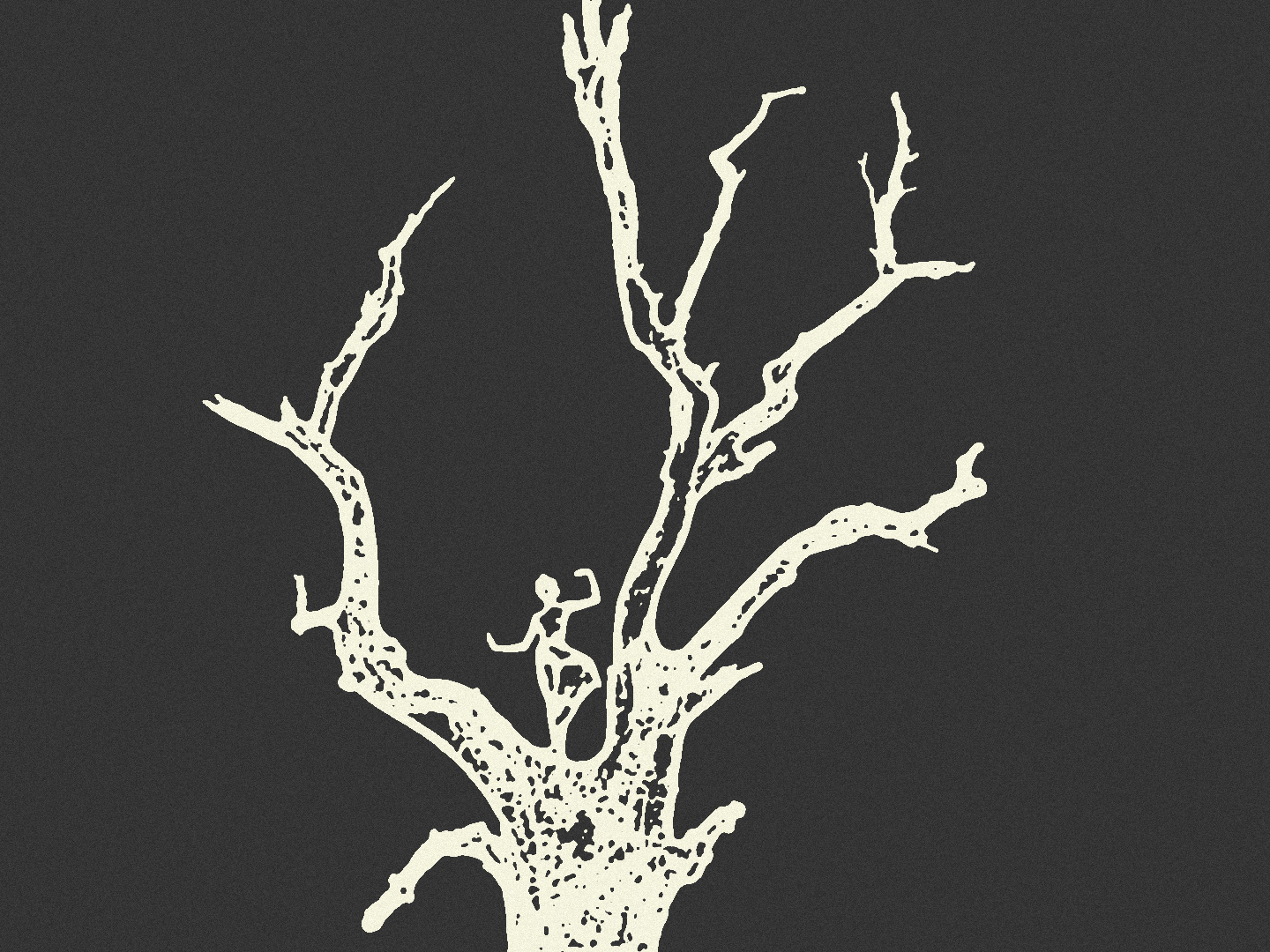
The bees were congregating around a large knot on the trunk that strongly resembled a human face. It was all scrunched up, as if elderly or in pain, a leathery mass cast in a die of the firm, dark bark like a statue in bronze or an insect frozen in amber. The face seemed to cry out silently, to be communicating something that could not be heard with its mouth opened wide in a gaping lust for speech. Juneblue leaned forward, putting his ear down to the mouth to see if he could make out any words. He heard nothing but the frenzied buzzing of the bees.
The entire face was soon covered in the insects, and still more were arriving in clouds of frenetic energy. Their buzz was generally constant and steady, a cacophonous hum that seemed to echo dully in the air like the leftover resonance of the first explosion that created the universe, but would sometimes swell, suddenly, into a violent burst of noise, like a grenade blast blowing out a room. He was now completely obscured by the bees, hidden behind their veil of chaotic secrecy.
An idea suddenly struck him that made no sense at all, and it was precisely because it made no sense at all that he felt so strongly compelled to try it. He reached his hand out and inserted his middle and index fingers into the knot-face’s eyes, his ring finger and pinky into its nostrils, and his thumb into its mouth. His hand was horribly contorted, but he was able to make it work. The bark, seemingly so hard and stoic, immediately began to give and bend, and soon he could wiggle his hand to make the trunk split a bit in the middle of the humanoid growth. He removed his hand from the face, took his axe from his belt, and began to swing.
The tree split as if it were struck by lightning—as if Juneblue’s blade were crafted from the sky itself. Bark shattered and flew in smoldering splinters away from the wound. The trunk fell back with a tremendous thud, shaking the earth and leaving a large gash in the soil, disturbing the worms and pill-bugs that lived underneath and sending rocks and broken roots scattering through the air. In the center of the opened tree sat an old woman, silent and unperturbed despite the destruction of her home, surrounded by one of the altars that Juneblue had sought to destroy.
Her deep eyes surveyed the young lumberjack as if he were a stray cat she was considering adopting, a sullen and pitiful little creature who had just shown up at her doorstep bedraggled and beaten down by the unpredictable tides of life. There was a subtle, gentle sorrow in her gaze, easy to ignore but ripe with manifold implications that, if explored, gave immense meaning to her appearance. Her pupils drooped heavily inside their encasing eggs of lapis, pregnant with untold meaning—like paper lanterns hung from a casket, their humble facades bore a sense of significance that could not be articulated, that resonated beyond the stark simplicity of their physical existence.
Soon she spoke. Her voice was deep and somber, despite her small size. It almost seemed as if she was speaking from somewhere else, somewhere outside of her body. Her words rained down like sonic embers from the ether.
She described Juneblue’s childhood, his adolescence, his current young adulthood in all of its wholesome and unpleasant details. She explained things he had always wondered about with a lucid and unadorned understanding, sparing no necessary detail and omitting all superfluity. There was no room for the purely ornamental, no need for extraneous adornment. Her words were enough, and were beautiful.
The woman only spoke for a few moments, but it somehow felt like she had crammed hours’ worth of information into that short span of time. Her mouth opened and shut slowly, her lips moving like fat caterpillars within the silky cocoon of her soft and wrinkled skin, but her words spilled out quickly, in a torrent of flowing information. The world seemed to slow down to listen more closely as she spoke—the earth’s rotation crawled to a much lower speed, causing Juneblue to lose his footing and fall to the ground, as the planet took a pause to attend to her words.
She stopped speaking and pointed up toward the top of her altar, which was a wood panel painted to look like a sky. It was half night and half day, divided down the middle into sections of dark and light paint. Her finger held aloft, her knuckles wavering ever so slightly beneath the weight of old age and arthritic pain, Juneblue thought he realized, although she was silent now, what she was communicating to him: the sky she gestured to was indeed as real as his own, and part of a separate cosmos outside his own experience of reality. The woman lived in another world contained entirely within the tree, and although visible to him was still removed by a vast gulf of metaphysical distance. Her life was unfathomably separate from his own, her experience of the world radically alien. Yet still he understood her—still her language flowed like molten honey around his ears.
The altar around her began to spin, slowly at first, and then faster, faster, as if it were being powered by a hidden engine that was quickly gaining power. Soon the woman with the outstretched finger was just a blur, a whirl of color blending together with the colors of the spinning sky she had been pointing to, subject and object now fusing into one as they spun like clay on a wheel and blurred into a unified maelstrom of color and silence. They continued to spin until it seemed their speed would be uncontainable within the world, that they would fly headlong out of reality and into some other dimension of pure imagination or thought, crashing through space and time and denuding the frailty of reality, exposing it for what it was. And then the tree closed back up around them, reassembling its trunk and shielding the cacophony of motion like an egg protecting its chick, and that was that—Juneblue’s destruction was undone, the tree was once more whole, and he was left to wonder just what had happened and what it might mean, if anything at all.
He ambled home slowly, replaying what had happened in his head in an endless loop. The images of the woman and her self-contained sky haunted him like ghosts on celluloid degraded into near nothingness from many years of projection, specterish movies played on screens long rolled up and thrown away in theaters long since shuttered and converted into shops, or churches, or galleries, or simply torn down and left to rot in a landfill as the land they once occupied is redeveloped into a towering complex of new apartments with a glass exterior that itself shows the films of its reflections, movies played out on the many-faces screens of the windows rendering light in all directions. He could not shake his memories. They filled his mind like air in his lungs, overtaking consciousness as if by instinct. He felt that he and the woman were one, in some sense, just as the spinning had rendered the woman and her sky into one amorphous mesh of color and silence.
When he arrived home trophyless, his boasts unfulfilled, he was greeted with taunts and jeers from his siblings and parents, but he didn’t care. He could barely hear their voices as he walked to his room and shut the door as soundlessly as he possibly could, in a pale imitation of the woman’s profound quiet. He sat on his bed and thought and thought and thought, his mind working without any conscious interference, the memories still plaguing him and replaying without ceasing. He could not find rest. Soon evening fell, and then before he knew it the dead of night was bleeding into the early morning—and still he could not sleep. He went to his window and looked out at the moon, and thought he saw his memories playing upon it like a film projected on a screen.
He closed his eyes and let the memories wash over him, surrendering to their power. The ground below him washed away, and he thought he heard the woman’s silent voice again, speaking without speaking, whispering something he could not quite understand into his ear. When he opened his eyes the memories had faded into nothingness. Every sound was deafeningly beautiful—the ticking of a clock, the settling of the house, the rustle of a blanket. He was drowning in beauty, immersed in it utterly, inescapably. He could not escape its grasp—and he began to think that it might be a prison, this beauty, and cried out for the woman to speak once more—and covered his ears so as to better hear her speak.
✷
Ian Goodale's work has appeared in Always Crashing, The Hamilton Stone Review, Gone Lawn, and Maudlin House, in addition to other journals. He works as an academic librarian in Austin, TX, where he lives with his wife and children. His website can be found at iangoodale.com.